Vietnamese exporters are entering 2026 with greater reason to treat container planning and freight risk as part of the commercial order itself rather than as logistics work to be handled after production is complete. Vietnam closed 2025 with approximately US$475.06 billion in merchandise exports, up 17% year on year, reinforcing the country's dependence on efficient international transport. At the same time, the first weeks of 2026 demonstrated how quickly ocean-shipping assumptions can change. Some services began returning to the Red Sea and Suez Canal while other carriers continued or reinstated Cape of Good Hope routing. For furniture, rattan, bamboo, handicraft and homeware exporters whose products can be bulky relative to their value, the result is clear: carton dimensions, container utilization, booking windows, route alternatives and freight exposure increasingly need to be considered before a final FOB price and delivery commitment are accepted.
Shipping Entered 2026 With Route Normalization Still Uncertain
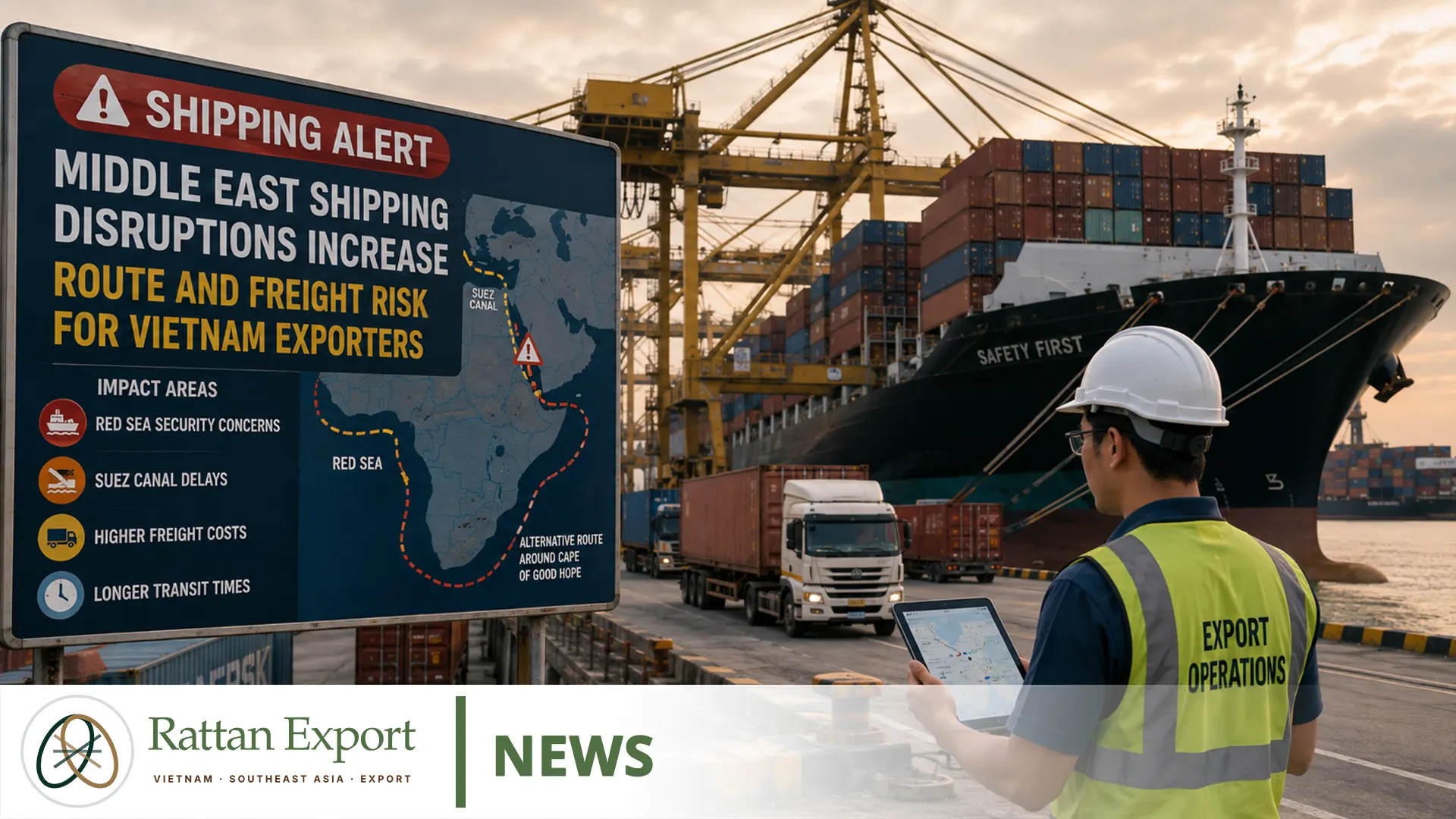
Global shipping entered the year in a transitional rather than fully normalized position. Maersk's January 8 global market update warned that a return to Red Sea and trans-Suez operations could itself introduce short-term volatility as vessels using the shorter Suez route and vessels already travelling around the Cape of Good Hope reached destination regions at different times. The carrier highlighted possible inventory, port-congestion and equipment-imbalance effects during the transition.
On January 15, Maersk confirmed a structural return of its MECL service to the trans-Suez route following what it described as continued improvement in conditions. Yet the market was not moving in a single direction. On January 20, CMA CGM announced that its FAL 1, FAL 3 and MEX services would for the time being operate via the Cape of Good Hope because of the complex and uncertain international context. Hapag-Lloyd's January operational update likewise described the Suez situation as fluid and maintained booking-management measures for several Middle East and South Asian markets.
For exporters, these different carrier decisions are more important than attempting to predict which route will become dominant. They demonstrate why a freight quotation, sailing schedule or transit-time assumption should be treated as time-sensitive information.
| Freight Variable | Potential Change | Exporter Impact |
|---|---|---|
| Routing | Suez or Cape of Good Hope | Transit time, fuel exposure and arrival dates can change |
| Available vessel space | Capacity can tighten by service or region | Booking may need to be secured earlier |
| Container equipment | Equipment can become imbalanced between regions | Empty-container availability can affect cargo readiness |
| Port congestion | Vessel bunching can increase terminal pressure | ETD and ETA reliability may weaken |
| Surcharges | Fuel, security, carbon or operational charges can change | Landed cost may move after the product price is agreed |
Vietnam's Export Scale Makes Ocean Planning Commercially Important
Vietnam's 2025 export performance shows why this matters. Preliminary Customs data placed total merchandise exports at about US$475.06 billion. Vietnam also operates through major container gateways. Government reporting based on 2024 throughput data placed Ho Chi Minh City Port at more than 9.1 million TEUs, Hai Phong at about 7.1 million TEUs and Cai Mep at more than 7 million TEUs. Hai Phong and Cai Mep are gateway ports capable of accommodating large container vessels and supporting direct international services.
Strong port infrastructure does not remove international freight risk. Once a container leaves Vietnam, its commercial outcome still depends on carrier networks, transshipment hubs, destination-port performance, weather, security conditions and equipment availability. Exporters therefore need to combine Vietnam's improving port capability with better shipment-level planning.
Furniture and Natural-Material Products Have a Special Container Problem
Furniture, baskets, lighting and natural-fibre décor often reach their container limit by volume before weight. A rattan chair can be relatively light but occupy substantial cubic space. A large pendant lamp may weigh only a few kilograms yet ship inefficiently if it cannot nest. A water-hyacinth basket set can perform very well in a container if sizes are designed to fit inside each other.
This means unit price alone is an incomplete commercial measure. For a B2B buyer, the more relevant comparison is often the cost of getting a saleable unit to destination.
| Product Data | Why It Matters |
|---|---|
| Finished dimensions | Determines product suitability and packaging design |
| Carton dimensions | Creates the actual CBM used for freight planning |
| Units per carton | Shows packing efficiency |
| Nesting quantity | Can significantly increase container utilization |
| Knock-down capability | Can reduce furniture shipping volume |
| Gross weight | Required for safe loading and transport documentation |
| 20ft / 40ft / 40HQ estimate | Allows buyer to compare freight cost per unit |
Container Planning Should Begin During Product Development
A common sourcing mistake is to approve the product first and calculate container economics later. By that stage, changing a chair frame, lamp diameter, basket proportions or carton layout may require new samples and delay production. Export-oriented product development should therefore include logistics questions before final approval.
For example, a furniture supplier may be able to make legs removable without affecting the visual design. A basket collection can be dimensioned around nesting ratios. Lampshades may be designed to stack. Several compatible SKUs can be developed around common carton modules. These decisions can create savings repeatedly across every future shipment rather than only reducing the factory price once.
20ft, 40ft and 40HQ Should Not Be Treated as Interchangeable
Different container types serve different order structures. A 20ft container may be appropriate for a dense or relatively small programme, while a 40HQ often provides a stronger volume opportunity for bulky furniture and homeware. But the largest container is not automatically the best commercial choice. MOQ, SKU assortment, demand, inventory exposure and destination handling all matter.
The correct workflow is to calculate packed CBM by SKU, build a loading plan and then choose the container format that fits the commercial order. Exporters should avoid promising an exact loading quantity based only on product dimensions because carton thickness, protection material, pallet use, loading orientation and safety clearance can change the final result.
Mixed-SKU Containers Can Improve Buyer Economics
For wholesalers, distributors and retail buyers, one of Vietnam's useful sourcing opportunities is the ability to build broader collections. A container might combine chairs, baskets, lighting and decorative products if suppliers, packaging and consolidation can be coordinated correctly.
Mixed-SKU loading can reduce inventory concentration and allow a buyer to test a wider assortment, but it increases planning complexity. Carton measurements must be accurate. Product readiness dates must align. Loading sequence should consider unloading needs at destination. Fragile or crush-sensitive products must not be placed beneath heavy furniture cartons. Supplier documentation also needs to match the final consolidated shipment.
Freight Risk Is More Than the Ocean Rate
The freight quotation is only one component of logistics risk. A lower ocean rate can become commercially irrelevant if the shipment suffers rollover, storage, demurrage, detention, rebooking or destination congestion. Exporters and buyers should therefore examine the complete shipment process rather than focusing on one headline freight number.
- Booking risk: is space actually confirmed on the intended sailing?
- Equipment risk: is the required empty container available at the correct depot?
- Schedule risk: how reliable is the announced ETD and ETA?
- Route risk: can the service switch between Suez and Cape routing?
- Transshipment risk: how many connections are required?
- Port risk: are origin or destination terminals experiencing congestion?
- Cost risk: which surcharges are fixed and which can change before shipment?
2026 Also Brings More Carbon-Related Maritime Cost Exposure
European-bound shipping also operates under a changing regulatory cost environment. Maritime transport has been incorporated into the EU Emissions Trading System, with the surrender obligation being phased in and additional greenhouse gases entering scope from 2026. FuelEU Maritime has also been in application since 2025. These systems are obligations on shipping operators rather than Vietnamese furniture exporters directly, but carriers may reflect regulatory costs in their commercial pricing and surcharge structures.
For buyers, the practical lesson is not to guess future carbon charges. It is to request current all-in freight assumptions and identify which cost elements remain subject to adjustment.
Vietnamese Exporters Need a Freight Scenario, Not One Freight Number
A more resilient quotation process can show several scenarios instead of pretending that logistics conditions are fixed. The supplier may quote the goods FOB while providing estimated loading quantities. The buyer or sourcing partner can then compare carrier options, routes and destination costs separately.
| Scenario | Planning Question |
|---|---|
| Base case | What is the expected route, transit time and freight assumption today? |
| Route change | What happens if the service diverts around the Cape? |
| Delayed sailing | How much production and warehouse flexibility exists? |
| Equipment shortage | Can empty-container pickup dates be adjusted? |
| Freight increase | Does the buyer still meet the target landed cost? |
Container Planning Should Be Part of the RFQ
For furniture and natural-material sourcing, an RFQ should capture logistics information from the start rather than requesting only MOQ and FOB price.
- Product and packed dimensions.
- Units per carton and carton gross weight.
- Whether nesting, stacking or knock-down packing is possible.
- Estimated loading quantity for 20ft, 40ft and 40HQ where applicable.
- MOQ by SKU and total order.
- Production lead time and cargo-ready date.
- Preferred port of loading.
- Destination port and country.
- Required packaging, labeling and moisture protection.
- Whether the shipment will be single-supplier or consolidated.
What This Means for Rattan Export Vietnam Buyers
Container economics and freight uncertainty are particularly relevant to the B2B sourcing model being developed by Rattan Export Vietnam. Buyers of rattan, bamboo, seagrass, water-hyacinth furniture and homeware cannot evaluate a commercial programme from product photographs and unit prices alone.
Our developing product catalogue is designed around supplier-linked products and structured material information, while the broader sourcing process can connect product selection with packing, quantity and container requirements. Buyers can review our approach to quality and compliance, learn more about Vietnam sourcing and export, or submit SKUs, quantities, destination, packaging and container targets through the wholesale inquiry.
Vietnam enters 2026 with strong export capacity and increasingly capable port infrastructure, but global ocean freight remains a variable that neither manufacturers nor buyers control completely. The commercial response is better planning: design products with freight in mind, calculate packed volume before committing to an order, maintain realistic route and schedule assumptions and compare sourcing decisions on landed economics rather than factory price alone.
Sources and Data References
- Vietnam Customs, preliminary assessment of 2025 international merchandise trade.
- UN Trade and Development, Review of Maritime Transport 2025.
- Maersk Global Market Update, 8 January 2026.
- Maersk MECL trans-Suez routing update, 15 January 2026.
- CMA CGM Cape of Good Hope routing update, 20 January 2026.
- Hapag-Lloyd operational update on the Red Sea/Suez booking environment, 26 January 2026.
- Viet Nam Government News reporting on Ho Chi Minh City, Hai Phong and Cai Mep container-port throughput.